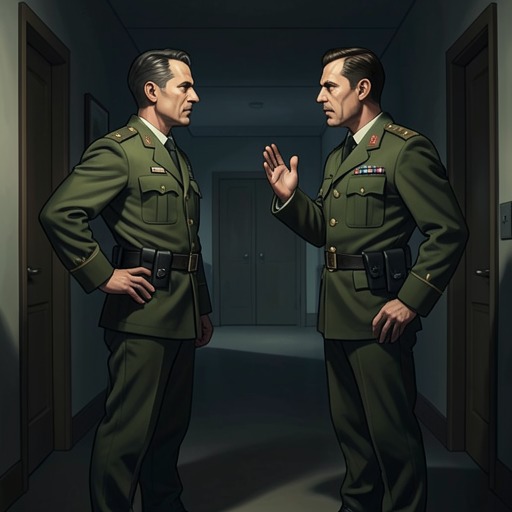
Georges Picquart—Major Henry
An Officer and a SpyGeorges Picquart and Major Henry are bound first by rank and necessity: Picquart takes charge of the Statistical Section, while Henry, appointed his deputy, possesses the experience required to keep its work running. Their working arrangement is marked by a contest over who controls sensitive information. The apparent peace that follows does not dispel Picquart’s doubts about Henry’s loyalties or judgment, and a later exchange about Esterhazy reveals that Henry had known of Esterhazy’s earlier employment in the section. In this fictionalized account, their relationship makes the chain of command itself a point of tension: authority belongs to Picquart, but knowledge and institutional memory are not his alone.
Appointment and Unequal Authority
When Major Henry comes to collect Picquart from the Ministry of War, he is to become the new chief’s deputy, a consolation for having been passed over for the leading position. Picquart describes their roles as an old military pattern: Henry is the experienced soldier who knows how to make the machinery work; Picquart is the younger commissioned officer theoretically in charge, whose decisions Henry may need to restrain. The arrangement gives each man something the other lacks, but it also makes friction foreseeable. Picquart has formal authority, while Henry has practical expertise and prior familiarity with the unit.
Henry’s manner sharpens that imbalance. He addresses the new chief as “Colonel Picquart!” with an emphasis Picquart reads as combining respect, congratulations, and mockery. Henry makes light of the foul summer air, too, joking that Picquart should be used to worse if he grew up on a farm. Picquart initially takes no offence and expects that, provided neither pushes the other too far, they can work together. His confidence is provisional from the outset: the relationship is framed not as uncomplicated trust, but as a mutual accommodation that depends on restraint.
A Dispute over the Intelligence Work
That accommodation is tested over material supplied by Agent Auguste. When Picquart learns that a batch arrived two nights earlier and Henry worked on it at home, he objects that such sensitive material should be brought directly into the office. His concern is procedural and operational: if the Germans learned what the section was doing, the handling of the material would have exposed its work. Henry assures him that the batch never left his sight, but Picquart insists that this misses the point.
Picquart responds by claiming control over the Auguste material. He orders it brought directly to him, says that he will keep it in his safe, and reserves the decision about which leads will be followed and who will handle them. When Henry begins to challenge the order on the grounds that Picquart is new to the work, Picquart stops him and invokes the unit’s military structure: Henry’s job is to obey his orders. Henry jumps to attention and answers, “Yes, Colonel.” The exchange settles who holds formal command, but it also shows how precariously that command has to be asserted.
Picquart extends the dispute beyond the material itself. He proposes excluding informers and other dubious visitors from lingering in the offices, introducing passes, restricting access to authorized personnel, and changing the section’s working arrangements. He then circulates a memorandum setting out the new rules and asks General Gonse for offices inside the main ministry building, or at least for the existing premises to be redecorated. These measures express a broader effort to replace secrecy and disorder with controlled procedures. For Picquart, taking charge means governing both the evidence and the space in which it is handled.
Accommodation, Observation, and Mistrust
The immediate confrontation does not become an open rupture. When Henry returns with the latest delivery, he shows Picquart the material he has reconstructed and offers to teach him how the pieces fit together. Picquart tries the work but finds it too intricate and time-consuming to take on while running the section. He clarifies that he wants first access for a preliminary look, while leaving the detailed reconstruction to Henry and Captain Lauth. Henry accepts the division of responsibilities, and Picquart reports that peace follows between them for the months that come.
Yet the calm is described as a surface condition, not proof that suspicion has vanished. Picquart sees Henry and others speaking quietly in the corridor and notices how quickly they disperse when he appears. On another occasion, outside Gribelin’s archive, he hears Henry complain that he cannot stand the way Picquart thinks himself cleverer than everyone else. Picquart cannot establish that the remark is about him, and allows that even if it is, a chief should expect to be criticized behind his back. His response keeps the working relationship intact, but it also shows the limits of what he knows: he observes signs of private resentment without claiming certainty about their meaning.
The difference between visible cooperation and uncertain allegiance also shapes Picquart’s occasional assumption of Henry’s methods. During the autumn and winter of 1895, Picquart learns the routine by which Agent Auguste signals a delivery: a particular flowerpot placed on her balcony in rue Surcouf indicates that she will be at the Basilica of Sainte-Clotilde at nine that evening. When Picquart asks to make the collection himself, Henry swallows his objections and agrees. The detail gives their relationship a practical rhythm: Picquart wants firsthand experience of the work, while Henry’s response suggests reluctance he does not openly turn into a dispute.
The Esterhazy Revelation and the Limits of the Record
The tension takes on a sharper significance when Picquart reports information from an old friend about Esterhazy: suspicious questions, paid visits to artillery exercises, copied firing manuals, and serious financial need. As Henry examines the petit bleu, he remarks that Esterhazy seemed fine when he worked in the section. Picquart is startled; Captain Lauth had not told him that Esterhazy had ever been employed there. Henry explains that it was long before Lauth’s time and that Henry himself had only just been posted to the section. The exchange adds a new fact to Picquart’s inquiry while locating Henry, through his earlier service, within the section’s institutional memory of Esterhazy.
The scene does not, on the evidence presented here, establish that Henry’s past knowledge proves complicity in Esterhazy’s conduct. Its force lies instead in the asymmetry it reveals: Picquart is the chief directing the inquiry, yet Henry possesses relevant history that Picquart and Lauth do not share. The subordinate who had resisted being overruled is also a source of knowledge indispensable to understanding the case. That dependence complicates their earlier division between commanding officer and experienced deputy, without resolving the mistrust already present between them.
The Author’s Note places a further boundary around the relationship as represented. The book presents itself as a novelistic retelling of a real affair and says that its characters are not wholly fictional, while acknowledging that personal details have been dramatized and that Georges Picquart never wrote the secret account imagined by the novel. The relationship’s scenes should therefore be read as part of the book’s constructed narrative, not as a documentary record of every exchange between the two men. Within that narrative, Henry and Picquart’s uneasy partnership stages a central problem of the inquiry: command can be formally assigned, but access to evidence and knowledge of the institution remain divided.